Delivering Northern Ireland’s First Passivhaus Plus Project
As the construction industry continues to address the challenge of reducing carbon emissions, Passivhaus is emerging as one of the most effective and proven building standards for energy efficiency. Buildings account for approximately 35% of global energy consumption, making energy efficient design and construction essential in the journey towards a lower carbon future.
With 30 years of international research and performance data, Passivhaus provides a robust framework for creating buildings that require very little energy for heating and cooling. Thousands of buildings across the world have achieved Passivhaus certification, demonstrating that high performance and sustainability can be achieved without compromising on quality or comfort.
One of the key advantages of Passivhaus is its ability to close the widely recognised performance gap between a building’s designed energy performance and its actual energy use once occupied. Research has shown that many UK buildings consume significantly more energy than originally predicted. Passivhaus buildings, however, consistently perform in line with their design expectations, delivering reliable and measurable energy savings.
This level of performance is achieved through eight core Passivhaus principles, including high levels of insulation, exceptional airtightness, high performance windows, minimised thermal bridging, effective ventilation systems, detailed performance criteria, accurate modelling using the Passive House Planning Package, and stringent quality assurance throughout the design and construction process.
The Passivhaus Plus Standard
Passivhaus Plus builds upon the already demanding Passivhaus standard by incorporating renewable energy generation. A Passivhaus Plus building not only dramatically reduces energy consumption but also generates a significant proportion of the energy required to operate the building throughout the year.
The insulation requirements for Passivhaus Plus are particularly demanding. Walls, roofs, and floors must typically achieve U values between 0.10 and 0.15 W/m²K, requiring substantial levels of thermal insulation, often ranging from 250mm to 400mm depending on the chosen materials. Equally important is the creation of a continuous insulation layer around the entire building envelope to eliminate thermal bridging and prevent heat loss.
JP Corry’s Role in Northern Ireland’s Newest Passivhaus Plus Project
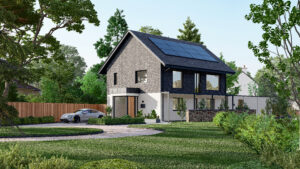
JP Corry was proud to work alongside Belfast Insulation on the specification and delivery of insulation solutions for Madden Contracts who are building Northern Ireland’s newest Passivhaus Plus project.
Working closely with project stakeholders, JP Corry played a key role in ensuring that the insulation specification met the exacting standards required for Passivhaus Plus certification. This included providing suitable insulation systems capable of achieving the demanding thermal performance targets while supporting the continuous building envelope required to eliminate thermal bridging.
By supporting the project team with product knowledge, JP Corry helped contribute to a building designed to deliver outstanding energy efficiency, occupant comfort, and long-term sustainability.
The project demonstrates how collaboration between suppliers, contractors, and specialists can help deliver some of the most energy efficient buildings in Northern Ireland. As demand for sustainable construction continues to grow, JP Corry remains committed to supporting projects that push the boundaries of building performance and help create a more sustainable built environment.